
Table of Contents
ToggleClash Royale’s visual appeal has always been one of its strongest assets. From the moment you place your first card on the arena, you’re surrounded by intricately designed troops, spells, and buildings, each with distinct personality and charm. But what goes into creating these iconic characters? And more importantly, how can you learn to draw them yourself? Whether you’re a casual player doodling during downtime or an aspiring artist looking to break into game illustration, understanding Clash Royale’s art style and learning to replicate it can deepen your appreciation for the game while building a valuable creative skill. This guide covers everything from analyzing official card designs to developing your own Clash Royale drawings, including techniques used by the community’s best fan artists.
Key Takeaways
- Clash Royale drawings succeed by prioritizing silhouette recognition, distinct color coding, and exaggerated proportions that balance cartoon charm with visual clarity.
- Master character construction through five foundational steps: block proportions with basic shapes, add volume, refine forms, include detailed expressions, and finalize with clean linework.
- Both digital tools (Procreate, Clip Studio Paint) and traditional media (quality pencils, markers, paper) produce excellent Clash Royale fan art—consistency matters more than your chosen medium.
- Dynamic posing, strategic shading, and action lines transform static Clash Royale character drawings into compelling battle scenes that capture the game’s fast-paced energy.
- Accelerate your growth by studying official card assets at high resolution, analyzing Supercell’s design philosophy, and engaging authentically with the active fan art community on Instagram, TikTok, and Discord.
- Share your Clash Royale artwork strategically with 2-3 posts weekly, relevant hashtags, captions inviting interaction, and time-lapse process videos to build consistent audience engagement over sporadic viral attempts.
Understanding Clash Royale’s Official Card Artwork & Design
Supercell’s design philosophy for Clash Royale prioritizes instant visual recognition and personality. Every card, from the Barbarian to the Mega Knight, carries a distinct silhouette, color palette, and attitude. This isn’t accidental: it’s foundational to how the game communicates with players in milliseconds during fast-paced battles.
The official artwork balances cartoon aesthetics with enough detail to feel tactile and real. Cards aren’t photorealistic, but they’re not purely stylized either. This middle ground makes them appealing to both casual and hardcore players while remaining readable at small sizes on mobile screens.
The Evolution of Card Art Styles Across Updates
Since its 2016 launch, Clash Royale’s visual style has subtly evolved. Early cards featured slightly rougher linework and more muted color schemes. The Barbarian, for instance, has been redrawn multiple times, his armor details have become sharper, his expression more expressive, and his overall proportions more dynamic.
Major updates have introduced art refreshes across entire card families. Building cards received visual overhauls to better reflect their in-game function, while spell effects gained more visual punch. By 2025-2026, Supercell moved toward slightly more polished, almost painted finishes on key cards while maintaining the series’ recognizable charm.
The meta-defining cards, like the Hog Rider or Royal Giant, received premium treatment with enhanced detail and dynamic posing. Meanwhile, card rarities (common, rare, epic, legendary) developed distinct artistic flourishes: legendary cards often feature premium gradients and more intricate backgrounds.
Character & Troop Design Principles
Clash Royale troops follow strict design rules that make them instantly identifiable:
Silhouette First: Each troop’s outline should be readable from across the screen. The Archer’s bow creates a distinctive shape. The Giant’s bulk is unmistakable. Good Clash Royale fan art respects this principle.
Color Coding: Supercell uses color to convey information. Goblins are green and chaotic. Knights are armored and blue-tinged. Archers are lean and often wear earth tones. This color language extends to spells and buildings, making the game more intuitive.
Personality Through Details: Troops aren’t generic soldiers, they’re characters. The Bandit’s smirk, the Princess’s confident stance, the Skeleton King’s regal bearing, these small details make cards memorable. When drawing Clash Royale characters, capturing this personality separates fan art from generic fantasy character sketches.
Proportions & Scale: Clash Royale exaggerates features for clarity and charm. Hands are often oversized, expressions are broad, and weapons are emphasized. This slightly caricatured approach differs from realistic anatomy but requires understanding proper proportions first to distort them effectively.
Creating Your Own Clash Royale Drawings: Techniques & Tips
Starting your Clash Royale artwork journey doesn’t require professional equipment or years of training. The game’s visual style is approachable once you understand its core principles. Breaking down the process into manageable steps helps you build confidence and develop consistent results.
Getting Started with Basic Character Sketches
Begin with construction lines and basic shapes. Clash Royale characters are built from simple geometric forms, cylinders for limbs, boxes for torsos, circles for heads. Don’t skip this step even if it feels tedious.
Step 1: Block Out Proportions
Start with a stick figure or basic skeleton. Map where joints bend, how long limbs are relative to the torso, and where the character’s weight rests. This applies whether you’re drawing the Knight or a custom troop inspired by Clash Royale’s aesthetic.
Step 2: Add Volume
Rough in cylindrical shapes for arms and legs, blocky forms for the torso. This step transforms your skeleton into something three-dimensional. Pay attention to the character’s stance, is the Hog Rider leaning forward aggressively? Is the Princess standing confidently upright?
Step 3: Refine Forms
Smooth edges, adjust proportions, add basic clothing and armor shapes. This is where personality emerges. The exaggerated hands typical of Clash Royale characters become evident here.
Step 4: Add Details & Expressions
Sketch facial features, armor plating, weapon details, and smaller accessories. Look at official card art for reference, the Princess’s crown design, the Barbarian’s armor patterns, the Archer’s bow curve.
Step 5: Clean Up & Ink
Erase guidelines, darken final lines, and prepare for color. This step separates your rough sketch from finished artwork.
Start by redrawing existing cards multiple times. This trains your eye to recognize Supercell’s proportions and style without the cognitive load of design invention. Once you’ve internalized these patterns, creating original characters within the Clash Royale universe becomes natural.
Digital vs. Traditional Media for Clash Royale Art
Both digital and traditional media work beautifully for Clash Royale fan art. Your choice depends on your goals and preferences.
Digital Art Benefits:
- Unlimited undos and layer organization
- Easy color adjustments and experimentation
- Scalability without quality loss
- Shareable directly online
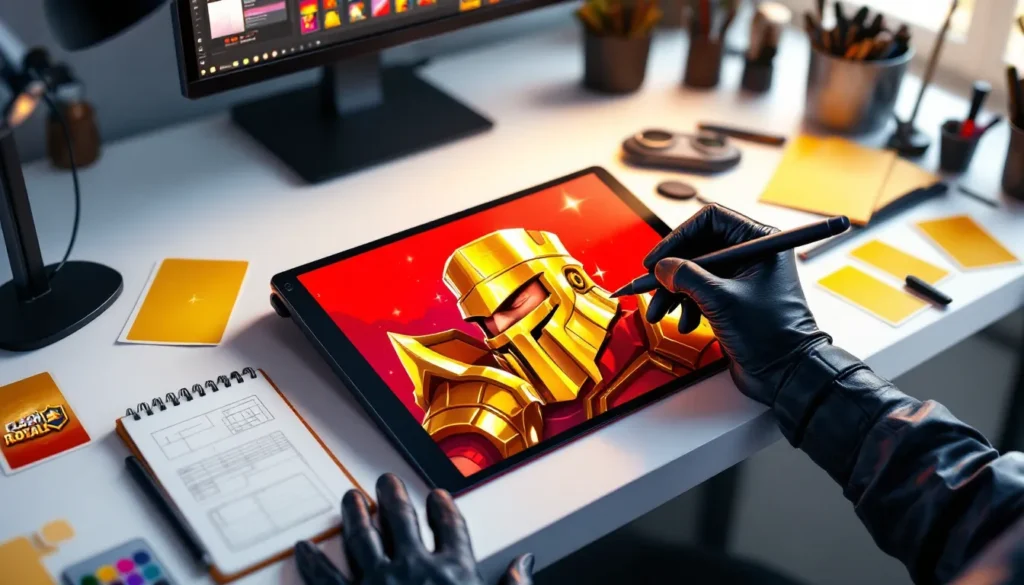
- Tools like Procreate, Clip Studio Paint, and Photoshop offer Clash Royale-friendly brushes
For digital work, invest in a tablet (iPad with Procreate is excellent but expensive: Wacom or Huion tablets offer better value). Start with free software like Krita or Ibis Paint X’s free tier.
Traditional Media Benefits:
- Tactile feedback and immediate results
- No technology barriers (pencil and paper work anywhere)
- Unique texture and materiality
- Some artists find it more meditative
- Physical artwork is tangible to display and gift
Traditional Clash Royale drawings photograph well for sharing online. Quality pencils (Caran d’Ache, Faber-Castell), markers (Copic or Posca), and good paper (Strathmore or Rhodia) enhance results significantly.
Many artists blend both: sketch traditionally, scan the image, and color digitally. This hybrid approach leverages each medium’s strengths. Your chosen platform matters less than consistent practice and understanding the fundamentals, so pick what’s accessible to you and start drawing.
Popular Fan Art Styles & Community Trends
The Clash Royale fan art community is vibrant and diverse. Artists approach the game’s visual language in dozens of ways, from strict adherence to official style to radical reinterpretation.
Trending Drawing Styles in the Clash Royale Community
Realistic Reimagining: Some artists render Clash Royale troops as if they existed in a darker, grittier fantasy world. The Knight becomes a weathered soldier. The Barbarian looks genuinely intimidating rather than cartoonish. This style appeals to players who enjoy fantasy worldbuilding and pushes the game’s established aesthetic in new directions.
Chibi & Super-Deformed: The opposite approach exaggerates proportions even further. Heads become enormous, limbs stubby, expressions comedic. Clash Royale’s existing cartoon charm makes it naturally suited to chibi interpretations. This style dominates in fan comics and lighthearted community content.
Anime-Influenced: Blending Clash Royale characters with anime art conventions, larger expressive eyes, specific hair styles, fashion details, remains consistently popular. The Archer and Princess adapt particularly well to anime styling.
Minimalist & Line Art: Clean, economical linework distills Clash Royale characters to their essential shapes. This style prioritizes clarity and often works as tattoo designs or logo inspiration.
Oil Painting & Traditional Realism: Some skilled artists translate card designs into painted artwork with visible brushstrokes and light modeling. These typically take weeks to complete but stand out dramatically in feeds.
Meme & Parody Art: The community loves comedic takes, overlarge Goblins, the Skeleton King as a romance protagonist, the Elixir Pump gaining self-awareness. These often go viral because they balance genuine skill with humor.
Observe trending fan art by following hashtags (#ClashRoyaleArt, #ClashRoyaleDrawing) on Instagram, Twitter, and TikTok. Notice what gets engaged with most and why. Sometimes technical perfection resonates less than authentic personality or emotional connection to character choices.
Showcasing Your Work on Social Platforms
Creating great art means nothing if it’s hidden in a sketchbook. Sharing strategically amplifies your growth and opens doors to collaboration.
Platform Selection:
Instagram dominates for visual art. The algorithm favors consistent posting (2-3 times weekly), relevant hashtags, and engagement with similar creators. Post high-quality photos of your Clash Royale drawings, not phone snapshots. Use 10-15 targeted hashtags per post.
TikTok and YouTube Shorts explode for time-lapse videos of your drawing process. Speed up 30 minutes of work into 15-second clips with trending audio. The algorithm heavily favors video content, making this format essential for growth.
Twitter works well for quick sketches, WIPs, and community conversation. Threads of process work (step-by-step from sketch to finish) often get retweeted heavily.
ArtStation and DeviantArt host your portfolio for credibility and discovery by potential clients or collaborators.
Strategic Posting:
- Post when your audience is active (typically evenings and weekends for US-based audiences)
- Use captions that invite interaction: “Which Clash Royale character should I draw next?”
- Tag relevant accounts (@ClashRoyale official, popular community channels)
- Engage authentically with other artists’ work before promoting your own
- Crosspost consistently but tailor captions to each platform’s culture
Consistency matters more than virality. One piece of exceptional Clash Royale fan art goes further than mediocre daily uploads. Quality with regular rhythm (even twice monthly) builds an audience far better than sporadic brilliant bursts.
Advanced Drawing Techniques for Clash Royale Art
Once you’ve nailed basic character construction, technical skills separate good Clash Royale drawings from exceptional ones. These techniques apply to both digital and traditional media.
Shading & Lighting for Depth
Clash Royale’s art uses strategic shading to create dimension without overwhelming the cartoon aesthetic. Heavy shadows would clash with the playful style, but flat coloring looks amateurish.
Value Control: Map light and shadow using grayscale first. Where does the primary light source sit? Typically, Supercell uses three-quarter lighting, light from upper left. Shadows fall on the right side of forms and undersides of features.
Create a mid-tone base color, then add shadows 1-2 shades darker and highlights 1-2 shades lighter. This subtle range reads as depth without cartoon realism.
Core Shadows & Reflected Light: The darkest shadows aren’t completely black. Add subtle reflected light (lighter shadow tones) on shadow-side forms where light bounces from nearby surfaces. A Barbarian’s armored shoulder casts a shadow on his chest, but reflected light from the ground keeps that shadow from being pure black.
Rim Lighting: Subtle light along edges, particularly hair, armor edges, and weapon silhouettes, makes characters pop. Don’t overuse this: one or two rim-lit edges per character usually suffice.
Ambient Occlusion: Where forms meet (where the arm attaches to the torso, between fingers), add subtle shadow. This grounds elements and prevents floating-limb syndrome.
Capturing Dynamic Poses & Battle Scenes
Static character portraits are fine, but battle scenes showcase Clash Royale’s action. Dynamic posing transforms drawings from illustrations to narratives.
Action Lines: Sketch invisible lines through your character’s pose that suggest movement. If your Knight charges forward, an action line runs through his weight-bearing foot through his head, showing forward momentum. Curve these lines slightly, straight action lines feel rigid. The Hog Rider leaning into a charge naturally curves differently than a defensive Princess.
Weight & Balance: Real weight distribution makes movement believable. A charging Barbarian’s center of gravity shifts forward over bent front legs. A retreating Skeleton leans back, weight on rear leg. Fail here and your character floats unconvincingly.
Foreshortening: Objects receding toward the camera appear shorter. A fist punching toward the viewer is shorter than a fist at the side. This technique adds urgency and immersion but requires practice. Reference photos and anatomical studies help enormously.
Overlapping Elements: In group scenes (multiple troops battling), overlap figures intentionally. Some characters sit in front, others behind. This 2D trick creates depth in ways subtle shading alone cannot.
Emotional Posture: Beyond physics, pose communicates emotion and intention. An attacking Archer stands differently than a retreating one. A confident Princess holds her staff differently than a desperate Wizard. Study official cards to see how Supercell conveys intent through posture.
When drawing battle scenes, sketch multiple characters first, their positions, overlaps, and interactions, before finalizing any single character. This prevents one figure from looking isolated in its finished quality compared to others.
Inspiration Sources & Research for Authentic Designs
Quality reference material elevates your Clash Royale drawings exponentially. Knowing where to find and how to use references separates amateur work from professional-adjacent pieces.
Studying Official Artwork & Game Assets
Supercell provides more reference material than most artists realize. Start with the obvious sources.
In-Game Cards: Open Clash Royale and examine each card at maximum zoom. Note armor textures, fabric wrinkles, weapon designs, color transitions. The official app is your baseline reference library.
High-Resolution Card Assets: Communities like Reddit’s r/ClashRoyale and fan sites host high-res card images. Some artists extract game files legally for detailed study. Download these and study specific elements: how armor seams line up, how cloaks drape, how hands grip weapons.
Official Updates & Announcements: Supercell’s blog and YouTube channel showcase new cards with concept art. Watch developer interviews discussing design choices. Understanding why a card looks certain ways informs your own design decisions.
Art Books & Dev Blogs: Supercell occasionally releases behind-the-scenes content. Search for “Clash Royale art process” or “Supercell design philosophy.” Similar games’ art books (especially other Supercell titles like Clash of Clans) reveal consistent design language across their portfolio.
Color Palette Analysis: Extract official cards’ dominant colors using design software. Most Clash Royale cards use 4-6 primary colors maximum. Document these palettes as reference for your own work. You’ll notice legendary cards use gold accents, common cards stick to primaries, rares introduce secondary colors.
Remember: studying official work trains your eye. You’re not copying, you’re learning the visual grammar Supercell uses. This knowledge transfers directly to original Clash Royale-inspired designs.
Learning From Pro Fan Artists
The Clash Royale community includes brilliant artists whose work rivals official quality. Following them accelerates your learning curve dramatically.
Process Content: Artists like those featured on major gaming blogs (resources like Game8 occasionally feature fan art spotlights) often post step-by-step creation videos. Watch their decision-making: color choices, line weight variation, composition choices.
Engage Respectfully: Comment thoughtfully on artists’ work. Ask specific questions about technique rather than generic praise. Many artists respond to genuine interest with advice or tutorial hints. The Clash Royale art community is generally welcoming to sincere engagement.
Study Their Mistakes & Pivots: Notice when a professional artist redraws a character or admits a version “didn’t work.” These moments reveal what they tried and rejected, invaluable learning. A redraw of the Hog Rider shows decision-making more than a perfect final piece.
Cross-Disciplinary Learning: Study fantasy artists unconnected to Clash Royale. Concept artists for other games, comic artists, illustrators, their techniques translate. A character design artist’s approach to silhouettes applies directly to Clash Royale card art.
Join Art Communities: Discord servers, Reddit communities, and forums dedicated to Clash Royale fan art provide feedback, challenges, and collaborative projects. Participating in monthly drawing challenges forces experimentation and gets your work seen.
Combine official reference with community learning: study Supercell’s established visual language, then see how skilled fans interpret and expand it. This balance grounds your work in the game while developing personal style.
Conclusion
Mastering Clash Royale drawings bridges gameplay appreciation with creative expression. You don’t need years of formal training, you need consistent practice, quality references, and willingness to iterate. Start by studying official card art to internalize Supercell’s design principles. The distinctive silhouettes, balanced proportions, and vibrant color choices that make cards instantly recognizable while drawing should inform your own work from day one.
The practical path forward is straightforward: sketch basic character shapes repeatedly until construction feels automatic. Move through digital or traditional media experiments to find your comfort zone. Share work online, engage authentically with the community, and learn from both official assets and skilled fan artists. As your fundamentals strengthen, layer in advanced techniques, sophisticated shading, dynamic posing, complex battle compositions.
Remember that even professional artists started with shaky first drawings. The Knight you sketch today informs the confident Clash Royale original character you’ll create in six months. Growth compounds through repetition, not talent alone.
Whether your goal is personal enjoyment, portfolio building, or community engagement, Clash Royale’s visual accessibility makes it perfect for artistic development. The game’s popularity means your work finds an audience genuinely interested in the aesthetic. That combination of welcoming community and rich visual language makes Clash Royale an ideal subject for deepening both your art skills and your connection to the game itself.